
It often starts as a hum. A background static that you’ve learned to ignore, until the volume cranks up and the static becomes a scream.
For many of the people who walk into my practice, the diagnosis isn't the first question. They come in exhausted. They talk about the restlessness that lives in their chest, the 30 browser tabs open in their brain, and the crushing weight of tasks left undone. They ask, "Why am I always on edge?"
We tend to treat ADHD and Anxiety as separate roommates living in the same brain. But in reality, they are often co-conspirators. They feed each other. They dance together. And understanding that dance is the only way to stop the music.
Therapist’s Note
I want you to pause here. Take a breath.
If you are reading this, you’ve probably spent years blaming yourself for being "lazy" or "high-strung." Let me offer you a different lens: What if your anxiety isn't a character flaw, but a structural necessity?
In my clinical experience, anxiety in the neurodivergent brain is rarely just "worry." It is often a vigilant guard dog barking at a world that wasn't built for you. You aren't broken; you are exhausted from translating your internal language to the external world.
The Architecture of Overwhelm
To understand why ADHD and Anxiety are so inextricably linked, we have to look past the symptoms and into the blueprint of the mind itself.
The "Hunter" in a "Farmer's" World
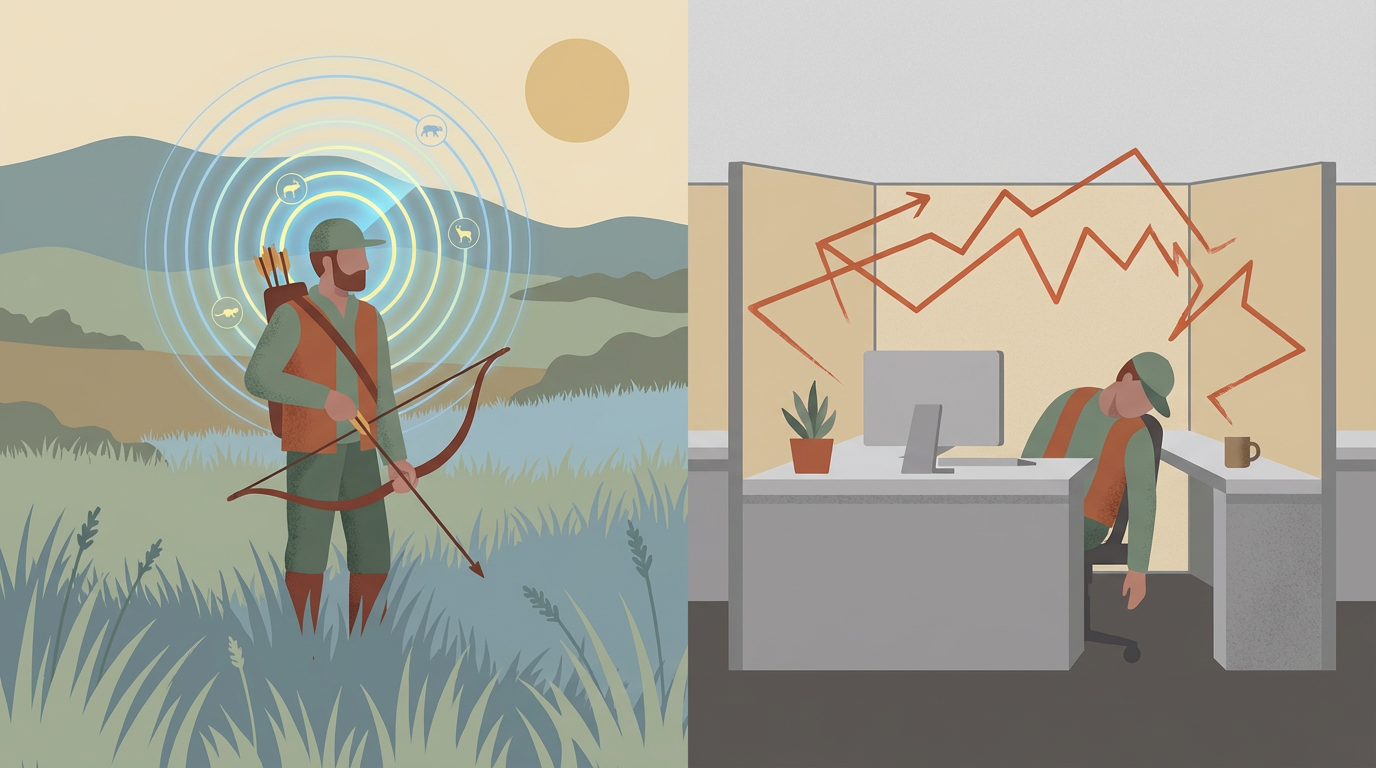
Imagine a hunter on the savannah. Their survival depends on scanning. A rustle in the grass? A shift in the wind? Their brain is designed to receive everything at once. High alert is their baseline. This is the ADHD brain.
Now, drop that hunter into a modern office cubicle—a "farmer's" world of linear spreadsheets, 9-to-5 schedules, and long-term crop planning.
The hunter’s scanning mechanism doesn't turn off; it just changes targets. Instead of predators, it scans for:
- Social cues you might have missed.
- Deadlines creeping up.
- The email you forgot to reply to.
This constant state of hyper-vigilance is what we medically label as anxiety. But evolutionarily, it’s just a radar system with no off switch.
The Cost of Masking
There is a hefty tax on pretending to be neurotypical. We call this Masking.
Masking is the act of manually operating your brain’s automatic transmission. It’s forcing yourself to sit still, to make eye contact, to nod at the right time, to check your list three times because you don't trust your memory.
This requires a massive amount of cognitive fuel. When the tank runs low, the brain triggers a stress response. Anxiety, in this context, is the smoke coming from an overheated engine.
The Causal Loop: Which Comes First?
This is the most common question I hear: "Do I have ADHD, or am I just too anxious to focus?" Or conversely, "Is my ADHD making me anxious?"
The answer is rarely a straight line. It is a circle. Let’s untangle the threads of Can ADHD cause anxiety and vice versa.
Scenario A: The Compensation Tax (ADHD Causes Anxiety)
For many adults, anxiety is a learned coping mechanism.
If you grew up with undiagnosed ADHD, you learned early on that your natural instincts led to trouble—forgotten homework, blurred outbursts, lost keys. So, you built a system of terror to keep yourself in check.
- You check the stove 5 times (because you’ve left it on before).
- You obsess over the calendar (because you’ve missed appointments).
- You over-prepare for meetings (because you fear your mind will go blank).
In this scenario, anxiety is the scaffolding holding the ADHD building together. If you treat the anxiety without addressing the ADHD, the building might collapse.
Scenario B: The Scattered Scanner (Anxiety Mimics ADHD)
On the flip side, Can anxiety cause ADHD-like symptoms? Absolutely.
When your brain is flooded with cortisol (the stress hormone), the prefrontal cortex—the CEO of your brain—goes offline. You become scramble-brained. You can’t focus. You jump from task to task.
The distinction lies in the origin story.
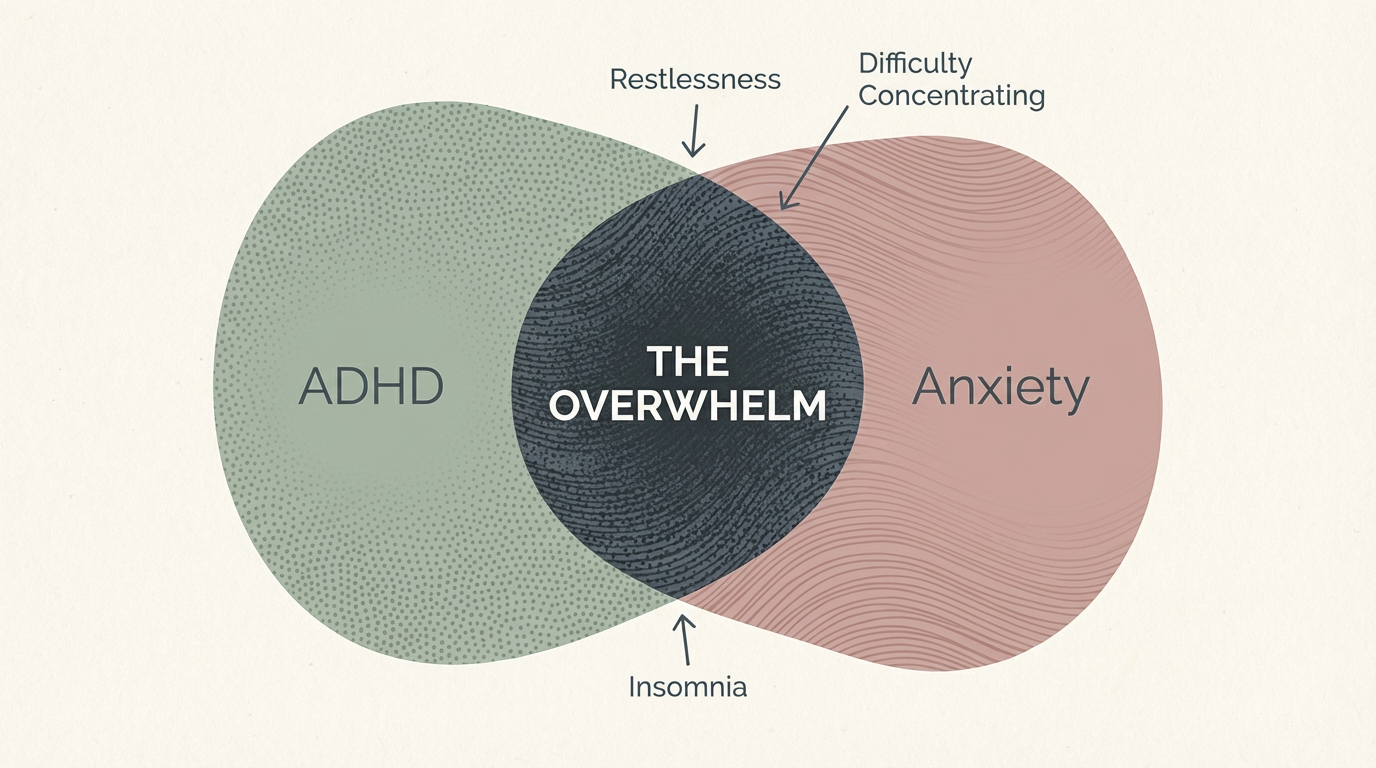
- ADHD is lifelong and situational-independent. The "noise" has always been there.
- Anxiety-induced inattention usually appears during periods of high stress and subsides when the stressor is removed.
The Venn Diagram of Symptoms
The Paralysis Trap: Why We Freeze
There is a specific, agonizing manifestation of this comorbid condition that deserves its own chapter: ADHD Paralysis.
This is not laziness. Laziness is a choice; you are enjoying the leisure. Paralysis is agony. You want to do the thing. You are screaming at yourself internally to do the thing. But your body remains glued to the couch.
The "Wall of Awful"
Why does this happen? It’s often an issue of Executive Dysfunction colliding with Perfectionism.
Every task has an emotional activation energy required to start it. For the ADHD/Anxiety brain, a simple task like "reply to email" isn't just a task. It is attached to:
- The shame of replying late.
- The fear of writing the wrong thing.
- The memory of previous failures.
These emotions build what Brendan Mahan calls the "Wall of Awful." To do the task, you don't just have to type; you have to climb the wall. And sometimes, the wall is just too high.
Therapist’s Note
I need to whisper this directly to the part of you that feels broken: Shame is a terrible fuel source.
Many of my patients try to whip themselves into action with shame. "Look at this mess, you're pathetic, get up!"
It might work for a sprint, but it burns out the engine long-term. Shame increases cortisol. Cortisol decreases executive function. By shaming yourself for being paralyzed, you are biologically adding more bricks to the wall you are trying to climb.
The antidote to paralysis isn't force; it is safety.
Rewiring the Narrative
We cannot "cure" the way your brain is wired, but we can change the operating system to reduce the friction.
Compassion as a Cognitive Tool
This sounds soft, but it is pure neurology. Self-compassion lowers the threat response in the amygdala. When you stop attacking yourself, your brain can reallocate energy from "defense" to "execution."
The Dopamine Menu vs. The Cortisol Spike
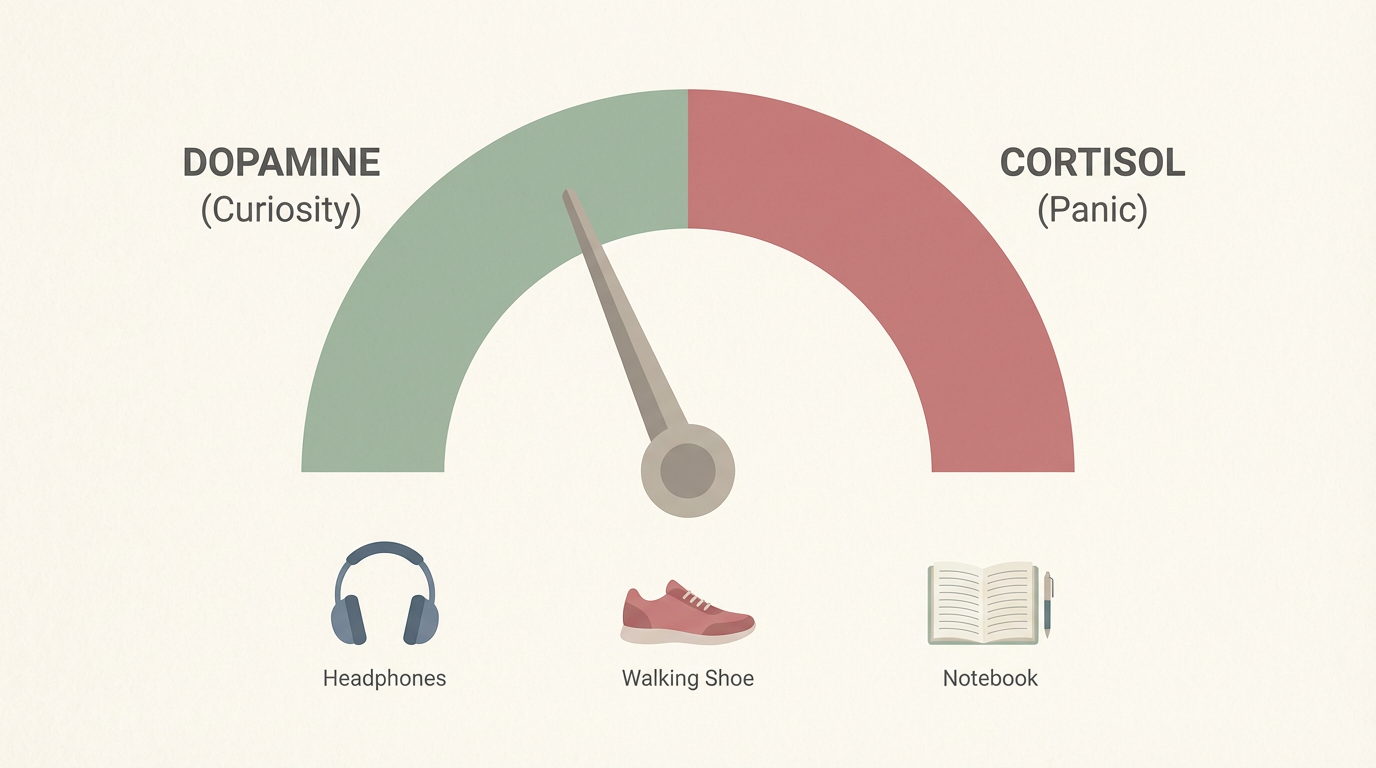
Your brain craves stimulation. If you don't provide it with healthy dopamine (interest, novelty, play), it will manufacture its own stimulation through cortisol (stress, panic, urgency).
This is why you procrastinate until 2 AM. You are waiting for the Cortisol Spike to become strong enough to override the dopamine deficit.
The goal is to build a Dopamine Menu: a list of sensory-friendly ways to engage your brain before the panic sets in. Music, movement, tactile play—these aren't treats; they are insulin for the ADHD diabetic.
Therapist’s Note
Healing is not about becoming a calm, linear, perfectly organized person. That person doesn't exist.
Healing is making peace with your own intensity. It is accepting that your hunter's mind will always scan, will always search, will always hunger. The goal is not to silence the noise, but to learn how to tune it into a frequency that plays music instead of static.
You are allowed to be complex. You are allowed to be messy. You are allowed to take the scenic route to your own potential.
But here lies a deeper truth: Identifying the noise is only the first step. The real work begins when you stop fighting your biology and start mapping it.
If this resonance feels familiar—if you felt a nod of recognition in your chest while reading about the "Hunter"—you might want to explore exactly where you sit on this spectrum.