You know the feeling. It’s the hum of the refrigerator that seems to scream while others sleep. It’s the shift in a friend’s micro-expression that tells you the dinner party is over, twenty minutes before anyone says goodbye.
For years, you may have carried this like a secret defect. You were likely told you were "too much," "too intense," or simply needed to "toughen up."
But here lies a deeper truth: You are not broken. You are built for high definition.
This is not a poetic metaphor; it is a biological reality. You are likely a Highly Sensitive Person (HSP), possessing a trait known scientifically as Sensory Processing Sensitivity (SPS). It is not a diagnosis. It is a distinct neurophysiological constitution that affects approximately 20% of the population—and it is time we rewrote the narrative from one of pathology to one of profound capacity.
Therapist’s Notes
"I often see clients curl inward when they first say the word 'sensitive.' There is a shame there, an echo of childhood voices telling them their reactions were wrong.
Let’s pause and honor that shame, and then gently set it aside. Your nervous system isn’t malfunctioning; it’s operating exactly as it was designed—to absorb, process, and feel the world with an intensity that is both a burden and a breathtaking gift."
The Architecture of Sensitivity (What It Really Means)
To understand the HSP experience, we must look under the hood. This isn't about being "emotional" in the way pop psychology suggests. It is about bandwidth.
The Biological Reality
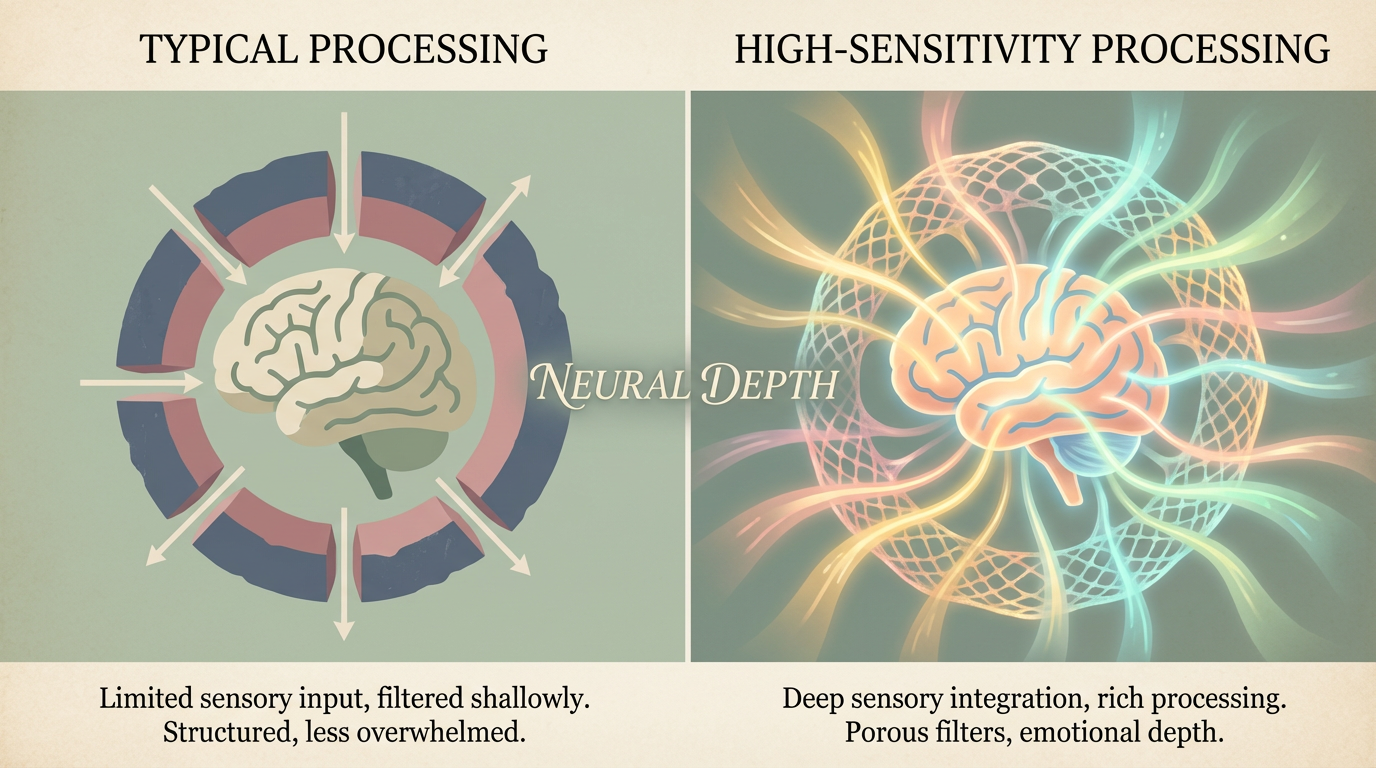
Research indicates that the HSP brain functions differently. Areas like the insula (the seat of emotional awareness) and the mirror neuron system (the empathy engine) show higher baseline activity.
Think of the average nervous system as a sturdy brick wall. It keeps most stimuli out, allowing only the loud and the obvious to pass through. The HSP nervous system, however, is not a wall; it is a finely tuned net. It catches the texture of the air, the undercurrent of a conversation, and the subtle shifts in lighting.
The "DOES" Model Reframed
Dr. Elaine Aron, the pioneer of HSP research, codified this into the DOES model. But let’s strip away the academic jargon and look at the lived experience.
- D for Depth of Processing: You don’t just hear news; you metabolize it. You are a deep diver in a world that often prefers to skim the surface. This is why small talk can feel excruciating—it offers no traction for your mind.
- O for Overstimulation: This is the tax you pay for high resolution. When you perceive everything, you deplete faster. A crowded mall isn't just a place; it's an assault of lights, noises, and energies.
- E for Emotional Reactivity & Empathy: You don’t just witness another’s pain; you feel it in your own body. Your boundaries are porous. This makes you an incredible friend and lover, but it also leaves you vulnerable to emotional contagion.
- S for Sensing the Subtle: You are the first to smell the rain or notice a typo in a document. You notice the invisible threads that hold a room together.
Mapping the Spectrum: Is It Rare? Is It Real?
The 20% Constant
One of the most common questions I hear is, "Why would evolution keep a trait that makes me want to hide under a blanket?"
The answer is survival. In evolutionary biology, this is often described as the "Orchid and Dandelion" hypothesis. Dandelions (the majority) can thrive anywhere. Orchids (HSPs) require specific conditions to bloom, but when they do, they are magnificent.
Tribes needed Dandelions to hunt and fight without hesitation. But they also needed Orchids—the sentinels who could detect the subtle scent of a predator or the shifting weather patterns before anyone else. Your sensitivity was not a flaw; it was the tribe’s early warning system.
Disorder vs. Trait
Let’s be crystal clear: High sensitivity is not a disorder. It is not listed in the DSM (Diagnostic and Statistical Manual of Mental Disorders).
- It is not something to be "cured."
- It is not a result of trauma (though trauma can heighten it).
- It is a neutral trait, like having blue eyes or being tall.
However, because HSPs feel so deeply, they are statistically more prone to anxiety and depression if their environment is chronically invalidating. The pathology lies not in the person, but in the mismatch between the person and their world.
The Confusion Matrix (Distinguishing HSP)
This brings us to the murky waters of diagnosis. Because the symptoms—overwhelm, withdrawal, intensity—overlap with other conditions, confusion is inevitable. Let’s disentangle the threads.
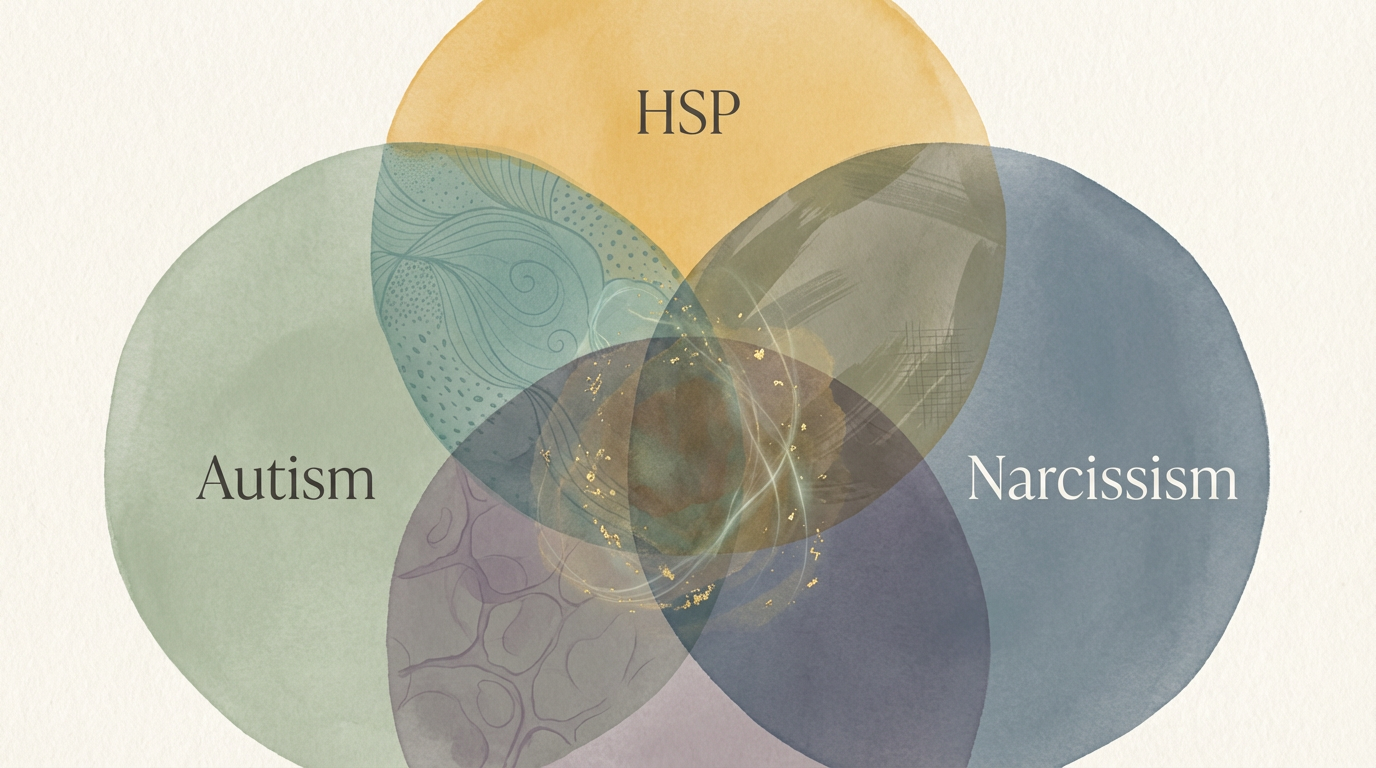
HSP vs. Autism
HSPs and autistic individuals often share a dislike for loud noises and a need for downtime (meltdown prevention). The divergence lies in social intuition.
HSPs are often hyper-attuned to social cues. They read faces and tone of voice with frightening accuracy. Autistic individuals, conversely, may struggle to intuitively grasp these unwritten social rules. While an HSP withdraws because they are feeling too much of the social dynamic, an autistic person might withdraw because the dynamic itself is confusing or over-stimulating in a sensory-only capacity.
Note: It is entirely possible to be both autistic and an HSP.
Empath vs. HSP
Are they the same? Almost, but with a nuance of mysticism vs. mechanism.
- HSP is the scientific container—the physiological wiring.
- Empath is the spiritual or energetic container—the experience of absorbing energy.
- Most Empaths are HSPs, but not all HSPs identify with the spiritual connotations of being an Empath.
The Shadow Question: Can a Narcissist be an HSP?
This is the question that often whispers in the dark: "I am so focused on my own feelings... am I a narcissist?"
There is a subtype of narcissism called Vulnerable (or Covert) Narcissism that mimics high sensitivity. These individuals are hypersensitive to criticism, introverted, and easily wounded.
But the distinction is fundamental: Empathy.
Therapist’s Notes
"If you are losing sleep worrying that you might be a narcissist, you almost certainly aren't one.
A narcissist's sensitivity is directed entirely inward—'How does this affect me?' An HSP’s sensitivity is omnidirectional. You feel your pain, but you also ache for the person who caused it. The Covert Narcissist uses their fragility as a shield to control others; the HSP usually tries to hide their fragility to avoid burdening others."
Living with High Definition
So, how do we inhabit this world without burning out? We must move from coping to curating.
The Canary in the Coal Mine
You are the canary. If the air in the mine is toxic, you fall first. This is not weakness; it is a signal that the environment is unsafe for everyone, the others just don't know it yet.
When you feel overwhelmed, do not ask, "What is wrong with me?"
Ask instead, "What is this environment telling me?"
Regulatory Anchors
You need anchors to keep from drifting into the storm.
- The Decompression Chamber: You cannot switch from a busy workday to family time instantly. You need 20 minutes of silence. Negotiate this.
- Sensory Diet: Curate your inputs. The fabrics you wear, the lighting in your home, the media you consume. These are not trivialities; they are nutrients for your nervous system.
- The "No" as a Complete Sentence: Protecting your energy is an act of service. When you are depleted, your empathy turns to resentment.
Therapist’s Notes
"The goal of therapy for an HSP is never to 'thicken your skin.' That would be like asking a violin to become a hammer.
The goal is to learn how to play your instrument. To know when to tighten the strings and when to loosen them. To realize that the same sensitivity that brings you to your knees in a supermarket is what allows you to experience art, nature, and love with a rapture that others may never know."
A Final Resonance
We live in a world that worships the loud, the fast, and the unfeeling. To be sensitive in such a place is a radical act. It requires a courageous tenderness to remain open when every instinct tells you to close. But your depth is needed. The world does not need more walls; it needs more people who can feel the wind changing.
If this resonance feels familiar, please look below and click the assessment card to begin mapping your unique spectrum.