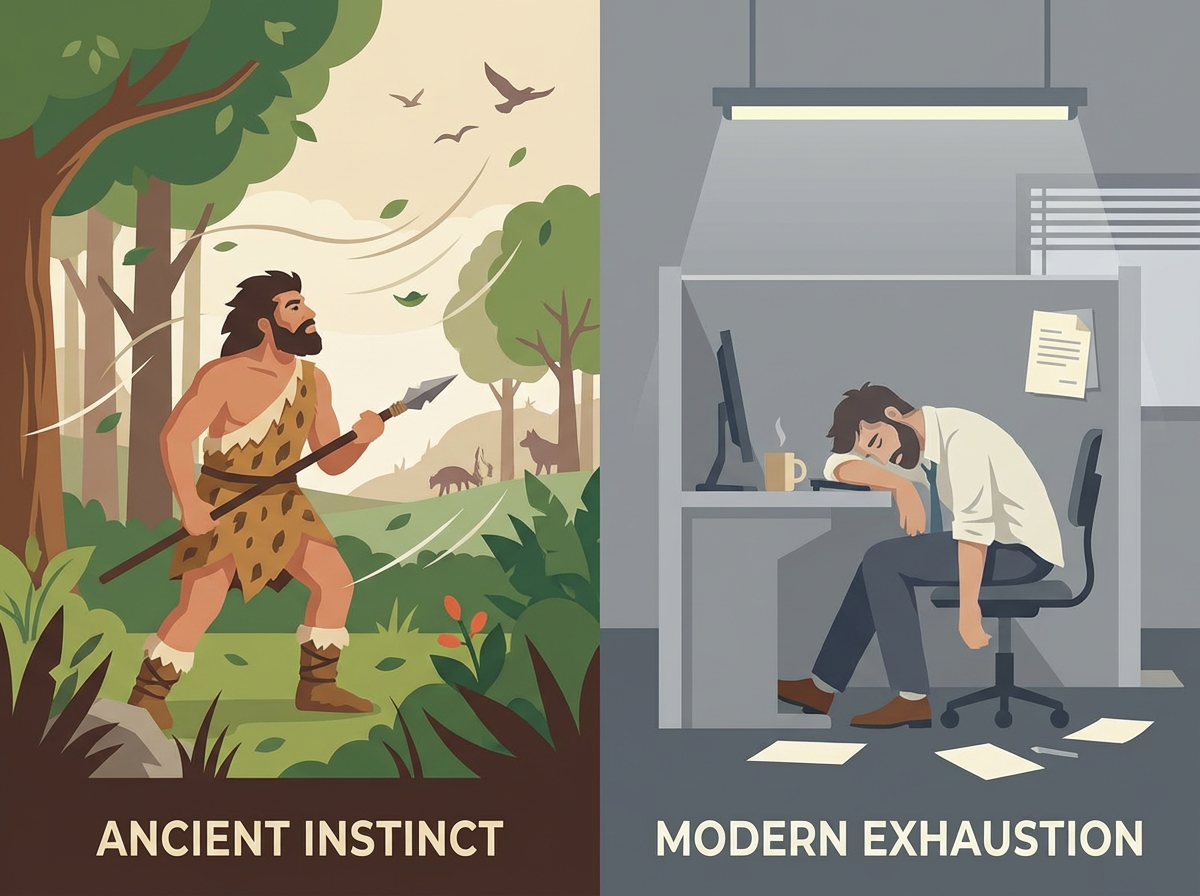
You are not broken. You are simply a hunter living in a farmer’s world.
If we rewind 10,000 years, your brain wiring would make you the tribe’s MVP. While the farmers were meticulously planting seeds in rows, you were the one scanning the horizon, hyper-aware of the snapping twig, the shift in wind, the sudden movement in the grass. Your distractibility was actually survival surveillance. Your impulsivity was rapid decision-making.
But today, we live in a world of spreadsheets, 9-to-5 schedules, and Zoom calls. The "Hunter" traits that once kept you alive are now labeled as a disorder.
Therapist’s Notes
I often see clients carry a heavy, invisible backpack of shame into my office. They tell me, "I just need to try harder." But let’s pause.
Imagine judging a cheetah for its inability to sit still and graze like a cow. The shame you feel isn’t a reflection of your character; it’s a symptom of a context mismatch. We aren't here to "fix" you. We are here to build a habitat where a cheetah can run.
It’s Not a Deficit, It’s a Difference
The term "Attention Deficit Hyperactivity Disorder" is a misnomer. You don't have a deficit of attention; you have an abundance of it. The problem is that your attention system is interested in everything.
How to manage ADHD starts with accepting this neurological reality: your brain is fueled by interest, novelty, challenge, and urgency. It is not fueled by importance or rewards that are far in the future.
Engineering Your "External Brain" (Management Without Medication)
Since your internal working memory might be a bit like a leaky bucket, we stop trying to patch the bucket. Instead, we build a reservoir outside of it. This is how to manage ADHD without medication—not by sheer will, but by superior design.
The Architecture of Attention
Your environment is your silent executive function. If your space is chaotic, your brain interprets that visual noise as unfinished tasks, draining your battery before you even start working.
The Golden Rule of Object Permanence: If you can’t see it, it doesn’t exist.
Don't hide your tools in drawers. But don't leave them in piles either. We need visual accessibility without visual clutter.
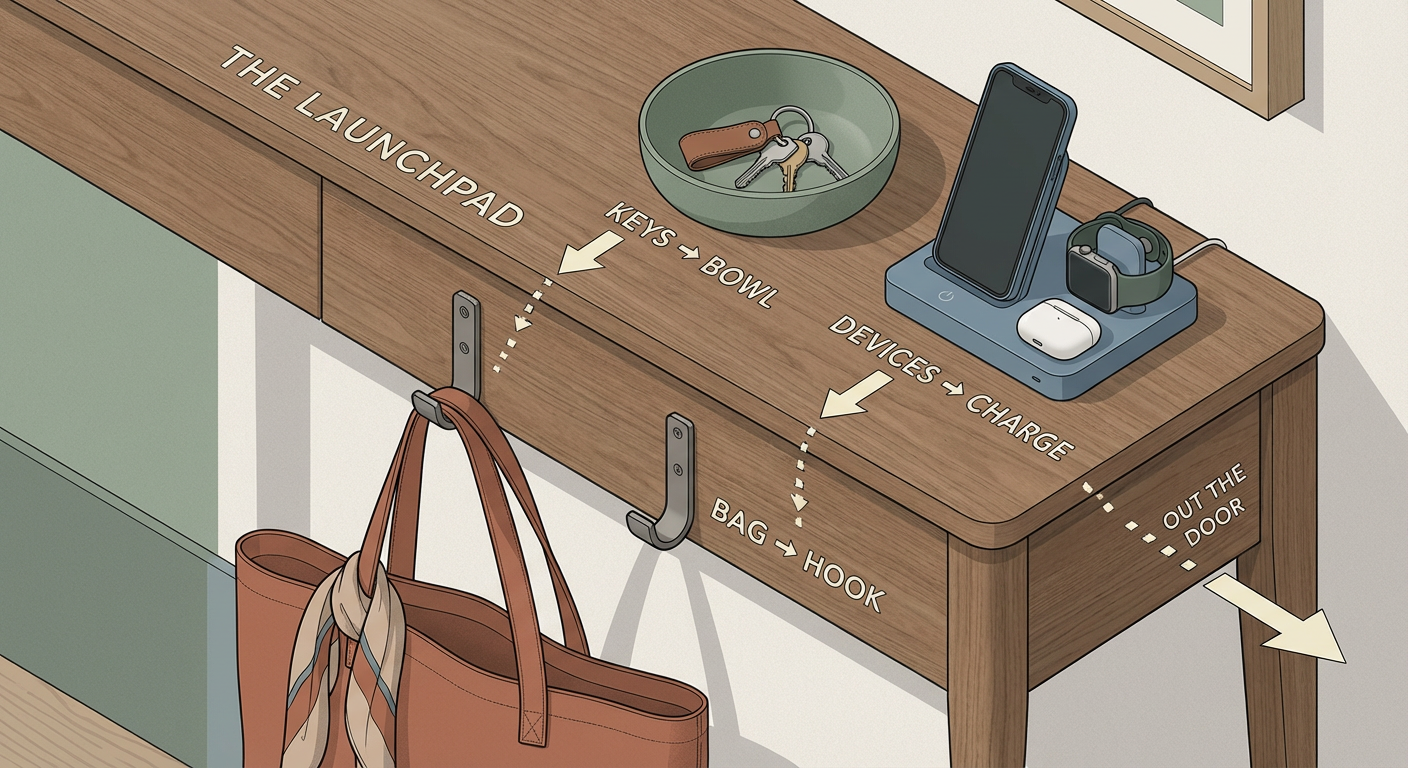
Reducing Cognitive Friction: The Launchpad
Every morning, you likely lose precious dopamine fighting the "Where are my keys?" battle. This isn't just annoying; it sets a tone of panic for the day.
Create a "Launchpad" at your front door. This is a sacred zone.
- The Bowl: For keys and wallet.
- The Hook: For the bag.
- The Charger: For the phone.
Therapist’s Notes
When you fail to put your keys in the bowl, catch the inner critic before it speaks. Don't say, "I'm so messy."
Say, "My system had too much friction."
Maybe the bowl is too high? Maybe it’s too full? Blame the design, never the person. This simple shift in language saves you hours of emotional recovery time.
The Bio-Hacking Protocol: Caffeine, Nutrition & Sleep
Biology comes before psychology. You cannot talk yourself out of a dopamine crash.
Does Caffeine Help ADHD?
This is one of the most common questions I get. The answer lies in the unique chemistry of the ADHD brain.
Caffeine is a stimulant. For a neurotypical brain, it might cause jitters. But for an ADHD brain, which is often starved of dopamine and norepinephrine, caffeine can sometimes bring you up to "baseline."
However, it’s a double-edged sword.
- The Paradox: Some of you might drink a double espresso and fall asleep. This happens because when your racing thoughts finally quiet down due to the stimulation, your exhausted body takes over.
- The Anxiety Trap: Too much caffeine can trigger the "fight or flight" response, masquerading as focus but feeling like panic.
The Protocol:
If you use caffeine, pair it with L-Theanine. This amino acid (found in green tea) smoothes out the jagged edges of the caffeine buzz, providing a calmer, more sustained focus. Think of it as putting shock absorbers on a race car.
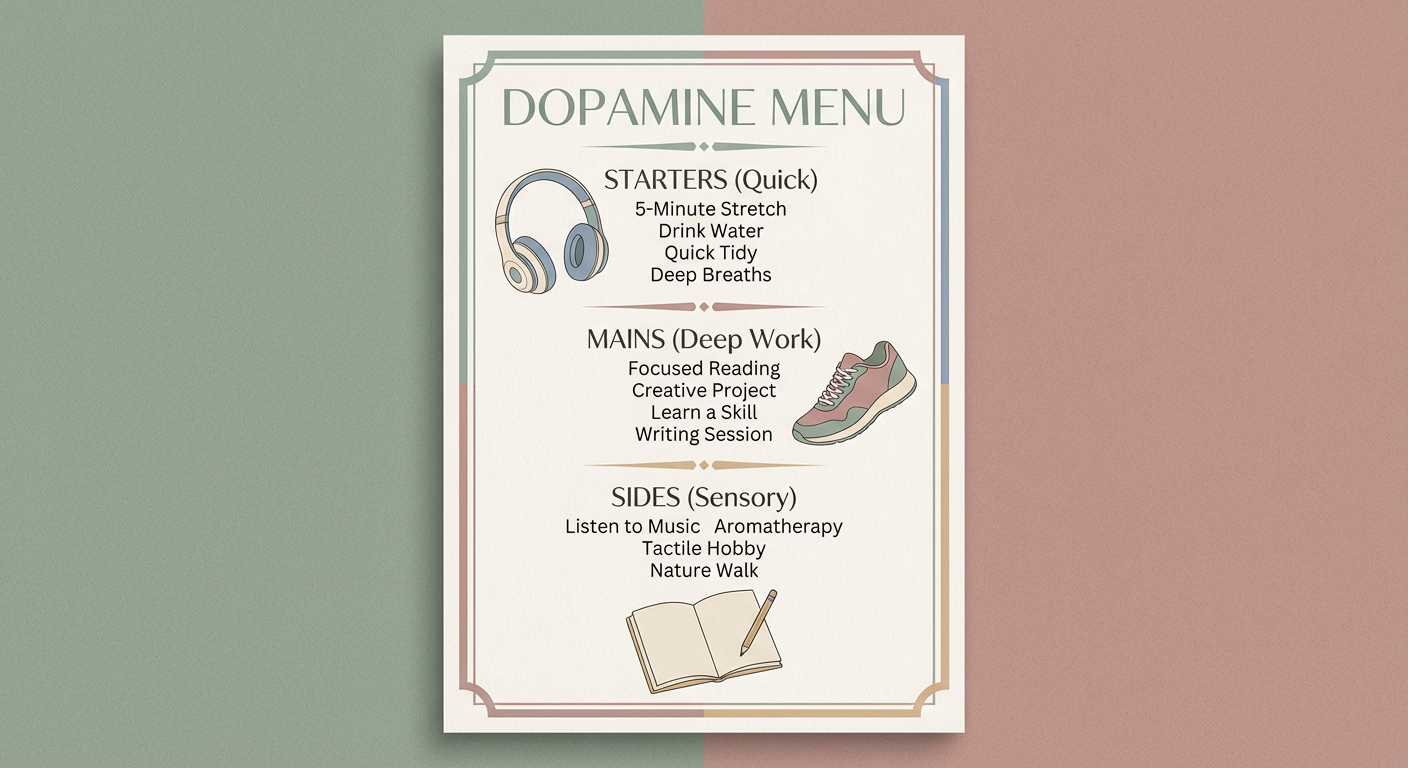
Designing Your "Dopamine Menu"
When you are low on dopamine, you will doom-scroll. That is your brain looking for "cheap calories." We need to prepare a menu of "nutritious dopamine" beforehand.
- Entrées (High effort, high reward): A intense workout, finishing a project, deep conversation.
- Sides (Low effort, medium reward): Listening to a favorite playlist, a cold shower, petting the dog.
- Dessert (Low effort, quick reward): Social media, candy. (Fine in moderation, but not as a main course).
The Emotional Core: Focus Follows Feeling
We tend to think of ADHD as a time management problem. But here lies a deeper truth: ADHD is an emotional regulation problem.
Navigating the "Wall of Awful"
You know that task. The one you’ve been putting off for three weeks. It’s not that the task is hard. It’s that every time you look at it, you feel a wave of guilt for not having done it yet.
Brené Brown talks about shame, and nowhere is it more palpable than here. You have built a "Wall of Awful" around that email. To scale it, you don't need a better calendar app; you need to lower the emotional stakes.
How to Focus with ADHD: The Body Double
When your internal motor is broken, borrow someone else's.
Body Doubling is the practice of working alongside someone else who is also working. They don't need to help you. They just need to be there. It activates a primal social instinct—the tribe is working, so I should too. It anchors you to the present moment.
Therapist’s Notes
I want you to practice a radical concept: The "Good Enough" Release.
Perfectionism is often just a shield against the fear of criticism. For the ADHD mind, "perfect" is the enemy of "done."
Give yourself permission to do B-minus work. A sent email with a typo is infinitely more valuable than a perfect email that exists only in your head. Forgive yourself for the typo. Celebrate the send.
Finding Your Rhythm
Managing ADHD is not about crushing your nature to fit into a box. It is about understanding the shape of your own mind and building a life that fits it.
It’s a journey from "Why can't I do this?" to "How can I do this my way?"
You are a hunter in a high-tech world. The goal isn't to become a farmer. The goal is to learn how to navigate the concrete jungle with the same grace your ancestors used in the wild.
If this resonance feels familiar, and you see yourself in the hunter’s reflection, you might want to explore exactly where you sit on this spectrum. Understanding your specific neuro-archetype is the first step to true design.