If you are reading this, you might be feeling a mix of exhaustion and curiosity. Maybe you’ve spent years wondering why "simple" tasks feel like climbing Everest. Or perhaps you’ve just received a diagnosis and are trying to make sense of the noise.
Here is the truth: The way the world talks about ADHD is often outdated.
We tend to speak about it as a behavior problem—a fidgety child disrupting a classroom. But as a clinical psychologist, I see something very different. I don’t see a deficit; I see a complex, high-energy nervous system that is struggling to regulate itself in a world designed for a different type of brain.
The Invisible Wiring: Defining ADHD
So, what is ADHD (Attention-Deficit/Hyperactivity Disorder)?
At its core, ADHD is a neurodevelopmental condition. This means it affects how your brain grows and develops. But let’s move away from the textbook definition for a moment.
Think of your brain’s executive functions as the conductor of an orchestra. In a neurotypical brain, the conductor waves the baton, and the violins play while the drums wait. In an ADHD brain, the conductor is often on a coffee break. The violins, drums, and trumpets are all playing brilliant solos, but they aren't always playing the same song at the same time.
This isn’t about intelligence. It is about regulation.
Therapist’s Note
In my sessions, I often tell my clients: You don’t have a shortage of attention. In fact, you have an abundance of it. You notice the hum of the fridge, the tag on your shirt, and the thought about 1990s pop music all at once. Your struggle isn't having attention; it is directing it to one single place when your brain wants to be everywhere.
The 3 Core Experiences (It’s Not Just "Fidgeting")
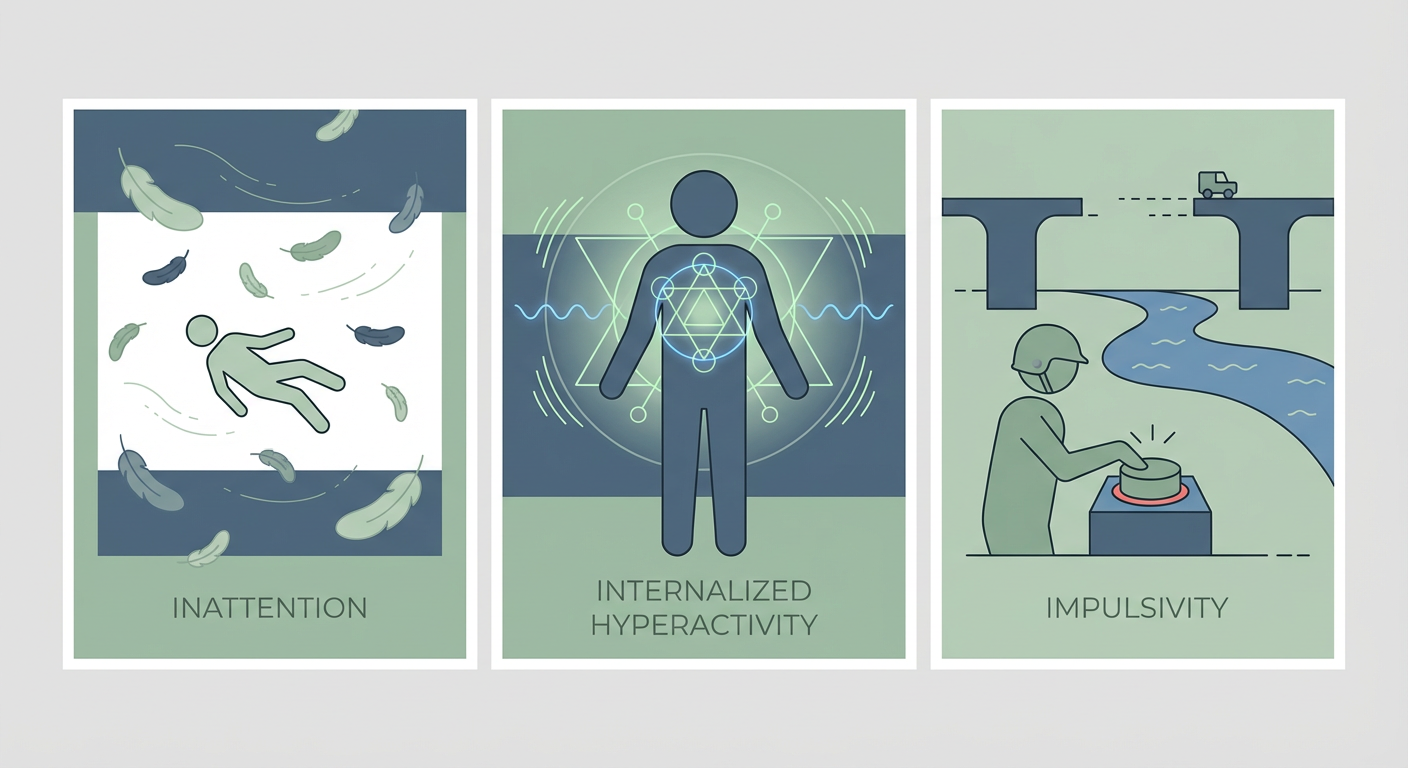
While the diagnostic manuals list eighteen criteria, the lived experience of ADHD usually falls into three emotional buckets.
1. Inattention (The Drifting Fog)
This isn't just "getting distracted." It is the painful inability to initiate a task you want to do. It’s reading the same paragraph five times and absorbing nothing. It is "time blindness"—where five minutes and five hours feel exactly the same.
2. Hyperactivity (The Motor That Won’t Stop)
For many adults, especially women, this doesn't look like running around a room. It becomes internalized.
- Racing thoughts that keep you awake at 3 AM.
- Compulsive skin picking or nail-biting.
- A constant, low-grade feeling of inner restlessness.
3. Impulsivity (The "Now" Button)
This is the inability to put a pause between a trigger and a reaction. It might look like interrupting a conversation because you’re terrified you’ll forget your thought, or buying three hobbies' worth of supplies at midnight.
Is ADHD a Mental Illness?
This is one of the most common questions I get: Is ADHD a mental illness?
The answer requires nuance. Technically, under medical frameworks (like the DSM-5), it is classified as a mental disorder. However, most modern psychologists and neurodiversity advocates view it differently.
We distinguish between Hardware and Software.
- ADHD is Hardware: It is the physical structure and chemistry of your brain (neurotype). It is how you are built.
- Mental Illness is often Software: Conditions like depression or anxiety are often distinct from your personality and can be treated or resolved.
While ADHD often co-occurs with anxiety or depression (often caused by the stress of living undiagnosed), ADHD itself is not an illness you "catch" or "cure." It is a way of being.
Therapist’s Note
I encourage my clients to view ADHD as a "neutral trait" in a "judgmental environment." Being left-handed isn't an illness, but using right-handed scissors is frustrating. Your brain isn't broken; it's just running a different operating system.
The Legal Reality: Is ADHD a Disability?
This question carries a lot of weight. Is ADHD a disability?
Yes. In the United States (under the ADA) and the UK (under the Equality Act), ADHD is recognized as a disability.
Why does this label matter?
- Protection: It protects you from discrimination in the workplace and school.
- Accommodations: It grants you the legal right to ask for tools that help you succeed, like noise-canceling headphones or flexible hours.
Many of my high-functioning clients resist this label. They say, "But I'm successful! I'm not disabled."
I invite you to look at the Social Model of Disability. This model suggests that you aren't disabled by your body, but by the barriers in society. If you were in a world that valued creativity, rapid problem-solving, and non-linear thinking, you might not feel "disabled" at all. You are disabled by the rigid 9-to-5 structure, not by your brain.
By The Numbers: How Common is ADHD?
You aren't alone on this island. When we ask how common is ADHD, the numbers are staggering.
- Global Prevalence: It is estimated that roughly 5% to 7% of adults worldwide have ADHD.
- The Gender Gap: Historically, boys were diagnosed 3 to 4 times more often than girls. However, we now know this was a bias in observation. Girls often present with "inattentive" symptoms (daydreaming) rather than "hyperactive" ones (disrupting class), leading to a "Lost Generation" of women diagnosed in their 30s and 40s.
If you feel like "everyone is getting diagnosed lately," it’s not a trend. It’s simply better awareness. We are finally turning the lights on.
Moving Forward
Understanding your wiring is the first step. The goal isn't to force your neurodivergent square peg into a neurotypical round hole. The goal is to reshape the hole.
Whether through therapy, medication, or lifestyle design, you can move from a state of chronic overwhelm to a place of thriving.

Curious About Your Own Wiring?
Do any of these descriptions feel like someone just read your diary?
If you found yourself nodding along to the "Internalized Hyperactivity" or the "Drifting Fog," you might be looking for clarity. While only a professional can formally diagnose you, understanding your baseline is a powerful place to start.
We have designed a clinically-referenced screening tool to help you visualize your traits.