You are competent. You have achieved things. To the outside world, you are a fully functioning adult, perhaps even a high performer. But inside, you are constantly putting out fires that no one else can see.
There is a specific texture to this exhaustion. It isn't just tired; it is soul-weary. It is the fatigue of a supercomputer trying to run modern software on an operating system that was never designed for linear, bureaucratic processing. You might find yourself paralyzed by a simple email reply for three days, yet capable of hyper-focusing on a passion project for twelve hours straight.
For years, you may have labeled this disconnect as a character flaw. You called it laziness. You called it a lack of discipline.
Therapist’s Note
I often hear patients describe a "secret defect" they’ve hidden since childhood—a fear that if people really knew how chaotic their internal world was, the admiration would vanish.
Let’s strip the moral judgment away right now. What you are experiencing is not a failure of will; it is a difference in wiring. You are not broken; you are a hunter living in a farmer’s world, desperately trying to plough a field using a nervous system designed for the hunt.
The Myth of Adult Onset: Why Now?
One of the most persistent questions I encounter in my practice is: Can you develop ADHD as an adult?
The strict clinical answer is no. ADHD is a neurodevelopmental condition, meaning it is woven into the fabric of your brain from the start. However, the experiential answer is far more complex.
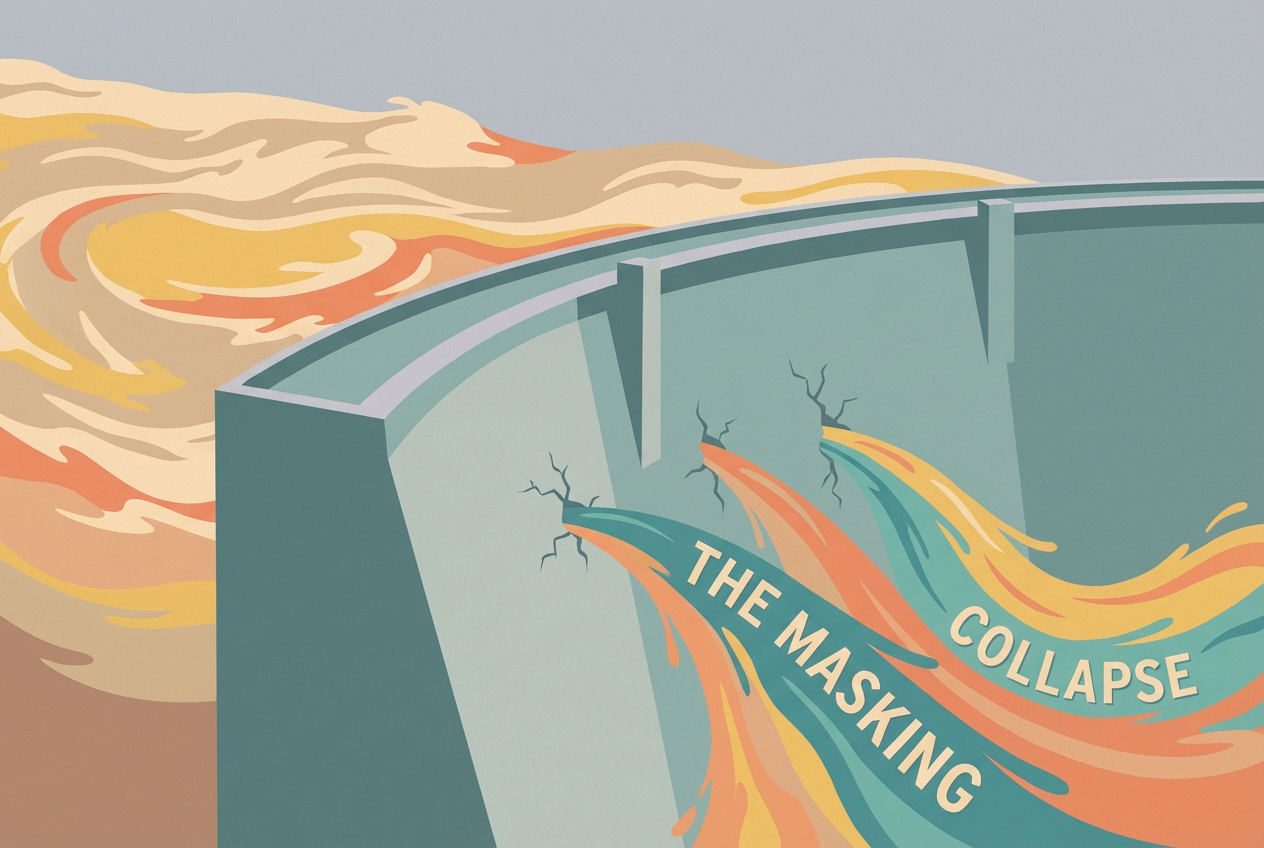
What you are likely experiencing is not "new" ADHD, but rather the collapse of your scaffolding. This is the Theory of Masking Collapse.
The High-IQ Camouflage
For decades, high intelligence or a highly structured environment (like school or the military) can act as a prosthetic frontal lobe. You might have used anxiety as fuel, procrastinating until the adrenaline spike of a deadline forced your brain into gear. You compensated. You masked. You white-knuckled your way through.
The "Tipping Point" of Adulthood
Then came the tipping point. Perhaps it was a promotion to management. Maybe it was the birth of a child. Suddenly, the inputs exceeded your system's capacity to compensate.
The executive functions required to manage a career, a mortgage, and a family simultaneously are exponentially higher than those needed to ace a college exam. You didn't "catch" Adult ADHD; you finally ran out of energy to suppress it.
Does It Get Worse with Age? The Contextual Mismatch
This brings us to the second terrifying suspicion: Does ADHD get worse with age?
It certainly feels like it does. Patients often tell me, "I used to be able to handle this. Now I can’t remember why I walked into the kitchen."
Biological vs. Environmental Load
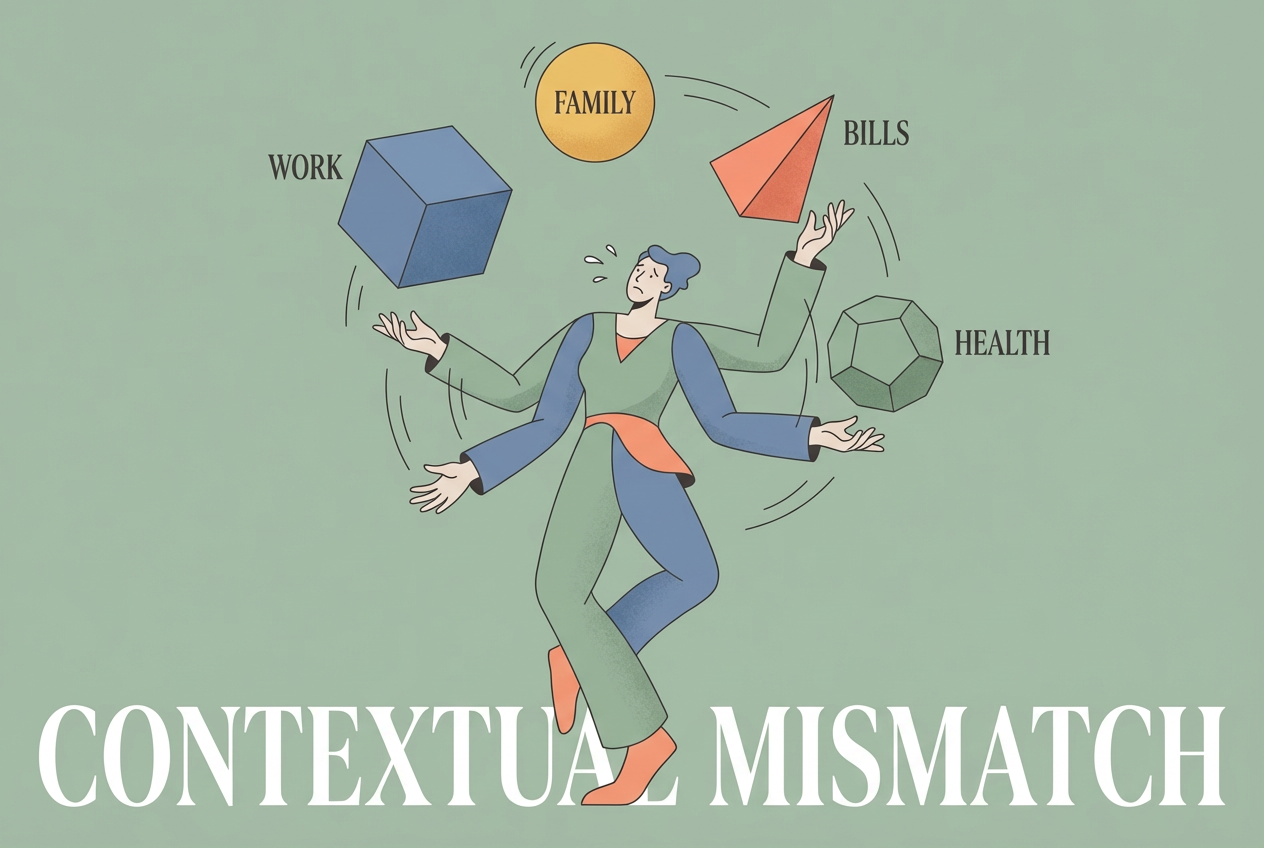
Biologically, the core deficit in dopamine regulation tends to remain relatively stable. However, the contextual mismatch widens.
Imagine your brain is a juggler who can perfectly handle three balls. In your twenties, life threw you three balls. You were a star. In your thirties and forties, life is throwing you ten balls—plus a chainsaw.
- Hormonal shifts (especially estrogen drops during perimenopause for women) can indeed exacerbate symptoms.
- Cognitive load increases while your energy to "mask" naturally decreases with age.
The result isn't necessarily biological degeneration; it is demand exceeding supply.
The Cumulative Toll of "Almost"
There is also an emotional compounding effect. Decades of "almost" achieving your potential, of missed appointments, of lost keys, and of social faux pas create a sediment of shame. This cumulative frustration can mimic worsening symptoms. You aren't just fighting the distraction; you are fighting the heavy memory of every previous failure.
Inside the Hunter’s Mind: A Neurobiological Reframing
To navigate this, we must understand the machinery. You do not have a deficit of attention; you have an Interest-Based Nervous System (IBNS).
The Myth of Importance
Most of the world operates on an "Importance-Based" system. If a task is important (e.g., paying taxes), they do it.
Your brain does not care about importance. It cares about:
- Interest (Is it fascinating?)
- Challenge (Is it difficult?)
- Novelty (Is it new?)
- Urgency (Is it due in 10 minutes?)
If a task lacks these four chemical hooks, your prefrontal cortex simply refuses to ignite. This is why you can be a brilliant coder or artist but fail to fill out a reimbursement form.
Therapist’s Note
I want you to pause and look at your relationship with Time.
Many of my ADHD clients suffer from "Time Blindness." They live in two time zones: Now and Not Now.
When you tell your partner "I'll be there in five minutes" and arrive in twenty, it is rarely a lie. In your mind, the transition truly felt instantaneous. But to the neurotypical partner, this reads as disrespect. Understanding this—that your internal clock has no second hand—is the first step toward forgiveness.
Love in the Distracted Age
ADHD doesn't just live in the brain; it lives between people. In relationships, the dynamic often devolves into a painful polarity: the Parent-Child Dynamic.
The Over-Functioning Partner
The non-ADHD partner often unknowingly slides into the role of the "manager." They remind, they nag, they rescue.
- The Danger: Erotic polarity requires mystery and autonomy. It is very difficult to desire someone you are constantly supervising.
- The Result: The ADHD partner feels controlled and rebels (or withdraws), while the non-ADHD partner feels lonely and overburdened.
The Dopamine of New Love
This is why Adult ADHD creates such specific turbulence in intimacy. The early stages of romance are a dopamine flood—perfect for the ADHD brain. You are hyper-focused on your lover. They feel like the center of the universe.
But as the relationship stabilizes and the dopamine settles, your attention naturally drifts. Your partner feels this shift as a betrayal. "You used to listen to every word I said. Now you're scrolling while I talk." They interpret a neurochemical shift as a loss of love.
Moving from Shame to Strategy
We cannot cure the wiring, but we can redesign the cockpit. The goal is not to become neurotypical; it is to build an External Brain.
1. Visual Cues Over Working Memory
Stop trusting your brain to "remember." It won't. If you need to take medication, tape it to the coffee handle. If you need to mail a letter, block the front door with it. Make the invisible physical.
2. The "Body Double" Technique
We often cannot initiate tasks alone. Working alongside someone else—even if they are just reading a book while you clean—can provide the "borrowed" executive function needed to start.
3. Radical Acceptance of Energy Cycles
Stop trying to work 9-to-5 if your brain lights up at 10 PM. Stop forcing linear planning if you think in mind maps.
Therapist’s Note
The ultimate victory in treating Adult ADHD is not becoming a perfect organizer. It is the cessation of the war against yourself.
It is looking at your piles of unfinished projects and seeing creativity rather than failure. It is realizing that your impulsivity is the flip side of your courage. When you stop trying to be a "farmer," you can finally start enjoying the hunt.
The Validated Self
We spend so much of our lives trying to flatten our waves to match the straight lines of the world. But the ocean does not apologize for its depth, and neither should you. The journey of Adult ADHD is not about fixing a broken machine; it is about learning to operate a high-performance engine that simply requires a different fuel.
If this resonance feels familiar—if you see your own reflection in the hunter’s mirror—you might want to explore exactly where you sit on this spectrum. Take the Archetype Assessment here to begin mapping your unique architecture.